
Taemin’s Postponed Tour Reveals the Hidden Barriers Facing Global K-Pop
Key takeaways
Quick summary- 1tour highlights how visa delays can disrupt entire international productions.
- 2The situation exposes the logistical barriers facing K-pop artists, touring crews, promoters, and fans as the industry continues to expand globally.
- 3Taemin’s postponed U.S.
Taemin in a promotional image for his 2026–27 LiMiNaL world tour. Original image courtesy of Galaxy Corporation via [Taemin’s official Instagram (@taemin_xoalsox)](https://www.instagram.com/taemin_xoalsox); edited for formatting.
The delayed U.S. leg of the LiMiNaL tour is more than a
scheduling problem. It exposes how immigration delays can disrupt an entire
international production.
By Cena Haddad
K-pop’s global expansion is often measured through sold-out arenas,
international chart positions, and the number of cities added to a world tour.
But reaching those stages depends on far more than demand.
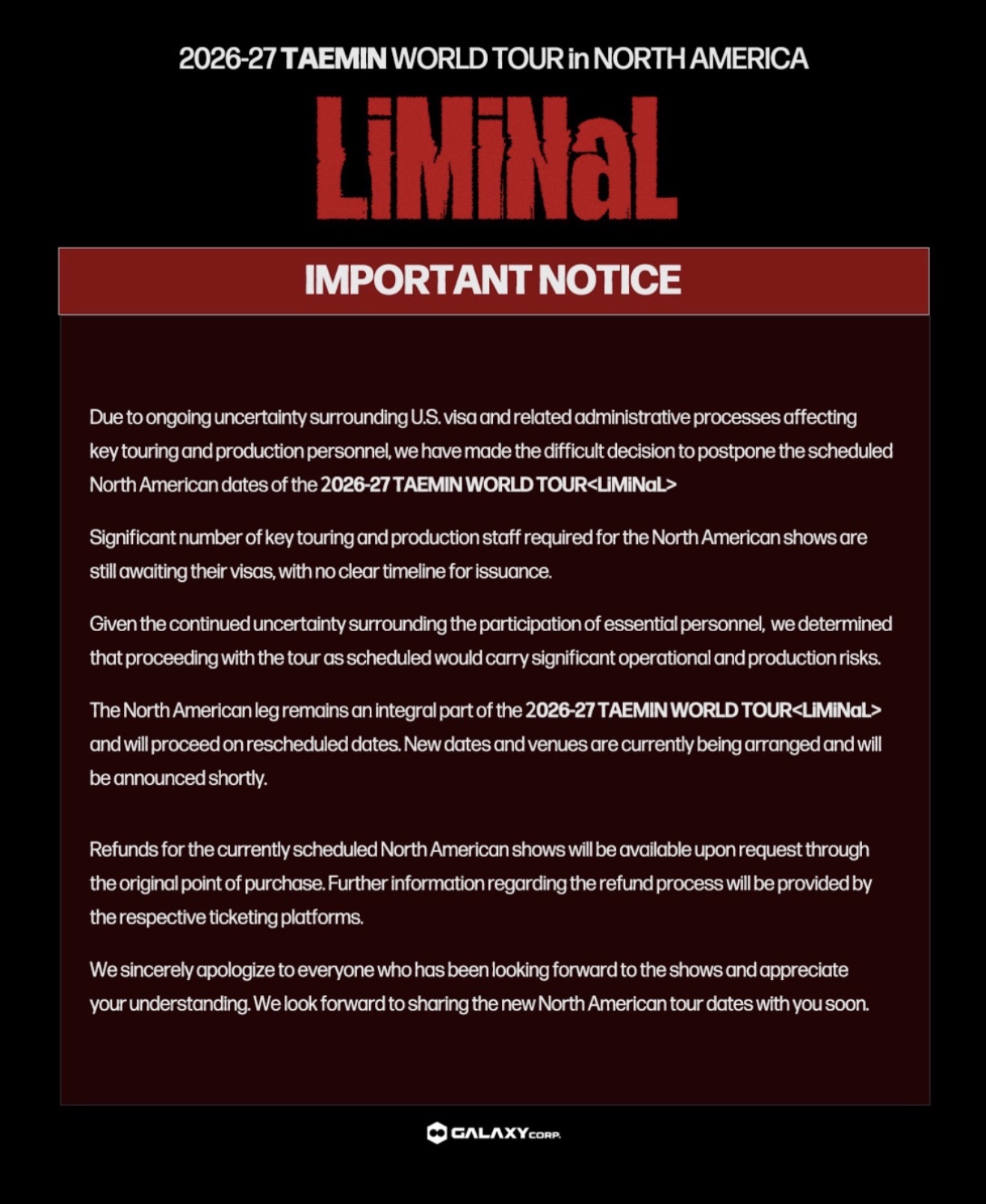
On September 29, Taemin’s team announced that all six scheduled U.S. dates
of his 2026–27 LiMiNaL world tour had been postponed because a
significant number of essential touring and production staff were still waiting
for visas.
The tour was scheduled to begin October 12 in San Jose before continuing
through Los Angeles, Las Vegas, Grand Prairie, Chicago, and Newark. The
announcement arrived less than two weeks before opening night.
With “no
clear timeline for issuance,” his team determined that proceeding without
key personnel would create significant operational and production risks.
New dates and venues are being arranged, while refunds are available through
the original points of purchase.
For fans, the news was a sudden interruption to a long-awaited tour. For the
industry, it exposed something larger.
A global performance does not travel with the artist alone. It depends on
the people responsible for preserving the show’s choreography, staging,
technical design, and overall production. When essential personnel cannot enter
the country, even an established artist with booked arenas and a ready audience
may be unable to present the show as intended.
Taemin’s postponement demonstrates the distance that can still exist between
K-pop’s global popularity and the systems required to support it.
A Tour Is More Than the Artist
A world tour is a traveling workplace.
Depending on the production, the people crossing borders alongside an artist
may include dancers, sound engineers, lighting operators, stage managers,
wardrobe teams, and other specialists responsible for making each performance
function safely and consistently.
Their work is especially important for an artist like Taemin, whose
performances depend on precise choreography and a carefully constructed visual
atmosphere. His presence may be central, but the complete show is built through
coordination with people who understand every transition, cue, and technical
requirement around him.
Replacing essential staff at the last minute is not as simple as hiring
local workers in each city. Touring personnel rehearse together, learn the
production’s systems, and carry that knowledge from one venue to the next. A
substitute may be talented, but talent does not replace preparation or
familiarity.
From the outside, a reduced production may appear to be an easy alternative.
It is not.
The postponement reflects how essential these personnel were to presenting LiMiNaL
as intended. Audiences purchased tickets for that complete performance – not an
improvised version assembled because immigration delays left the original team
incomplete.
Not an Isolated Delay
Taemin’s tour is not the only major K-pop event recently disrupted by U.S.
visa uncertainty.
In September, organizers postponed the four-day KPOPWORLD
Festival in San Antonio until 2027 after struggling to secure visas for
international artists and groups.
The festival was scheduled for October 28–31 at the Alamodome, with a lineup
that included Jay Park, The Rose, Wonho
×
 , Dayoung, and Cravity
×
, Dayoung, and Cravity
×
 . Organizers said
they had pursued expedited options but could not guarantee that the necessary
approvals would arrive in time.
. Organizers said
they had pursued expedited options but could not guarantee that the necessary
approvals would arrive in time.
Rather than present a significantly reduced lineup, they postponed the
entire event.
The repetition matters.
In March 2025, the Associated
Press reported that the filing cost for a musician’s visa petition had
risen from $460 to more than $1,615, while expedited processing could add
nearly $2,800.
At the time, immigration attorneys said some applications were taking as
long as eight months.
Touring creates a difficult cycle around that uncertainty. Artists need
confirmed performance dates before applying, but promoters, venues,
transportation, lodging, and ticket sales are often arranged long before the
government provides a final decision.
By the time a delay becomes impossible to ignore, money has already been
spent and fans have already built plans around the performance.
K-pop may have the audience required to fill American venues. That does not
mean the administrative system can reliably support the speed and scale at
which the industry now travels.
Fans Carry the Remaining Cost
A ticket refund does not make every fan financially whole.
Fans may have already booked flights, hotels, transportation, or time away
from work. Those expenses may be nonrefundable, and a rescheduled date may no
longer fit the same schedule or budget.
K-pop tours frequently visit only a limited number of cities, making travel
part of the concert experience for many fans. A single performance can require
months of saving and planning.
When the show disappears from the calendar, the loss extends beyond the
ticket.
That does not mean Taemin should have presented an incomplete performance.
Postponing was the more responsible choice once his team could no longer depend
on the necessary personnel being available.
The larger problem is that the decision had to be made so close to the
tour’s opening.
Immigration systems have legitimate reasons to review who enters a country
for work. The issue is not that every application should receive automatic
approval. It is that artists, workers, promoters, and audiences need a process
with timelines reliable enough to plan around.
K-pop is no longer approaching the United States as an occasional foreign
attraction. Its artists regularly book arenas, headline festivals, employ
international crews, and generate business for American venues and cities.
The infrastructure surrounding those performances has not always kept pace
with that reality.
Taemin’s postponed tour is disappointing, but it is also revealing.
Global popularity can create demand, sell tickets, and fill venues.
It cannot make an unpredictable immigration process move on the same
schedule.

Related groups
CRAVITY is a nine-member South Korean boy group under Starship Entertainment. The group consists of SERIM, ALLEN, JUNGMO, WOOBIN, WONJIN, MINHEE, HYEONGJUN, TAEYOUNG, and SEONGMIN. CRAVITY debuted on April 14, 2020 with the EP Season 1. Hideout: Remember Who We Are.









Hover or tap React to choose. Pick the same reaction again to remove it.
Comments
(Updates after load — yes, your readers are humans… mostly.)
Top reads this week
Last 7 days
Exclusive: KPopAngel Sits Down With V01D To Discuss Their New Mini Album, Debut Life, And Plans For The Future
1d ago

Hongjoong of ATEEZ Makes DJ Debut at EDC Korea
1d ago

Stray Kids’ Hyunjin Is the Prince of Dior at Paris Fashion Week 2026
4d ago
Watch: &TEAM Introduces Official “TEAMILY” Characters For Each Member
1d ago

In Case You Missed It: 10 K-Pop Releases to Catch Up on From September
2d ago
Related group news
Latest stories mentioning CRAVITY.